

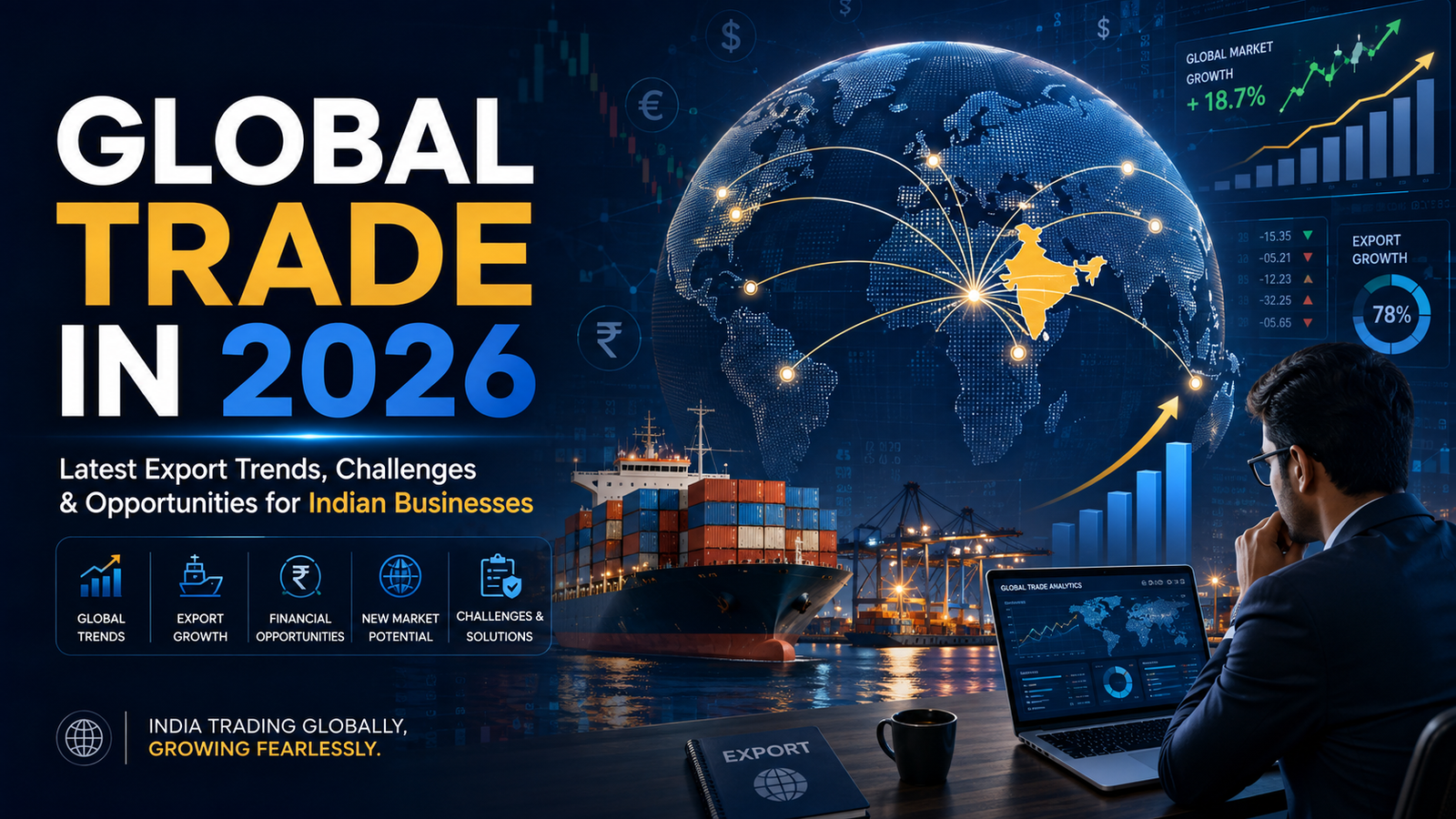
Global Trade in 2026: Latest Export Trends, Challenges & Opportunities for Indian Businesses
Global trade is changing faster than ever. In 2026, businesses are dealing with shifting supply chains, changing tariffs, geopolitical tensions, rising compliance requirements and rapid growth in digital and technology-driven trade. At the same time, these changes are opening new doors for exporters that can adapt quickly.
For Indian businesses, this creates an important opportunity. With strong manufacturing capabilities, a large domestic market and growing participation in international supply chains, India can strengthen its position as a global sourcing and export hub.
Latest Global Trade Trends in 2026
One of the biggest global trade trends in 2026 is the continued growth of technology-related trade. Demand for AI infrastructure, semiconductors, batteries, ICT products and electric vehicles has remained strong. UN Trade and Development reported that global goods trade reached around $13.7 trillion in the first half of 2026, while technology-intensive products recorded particularly strong growth.
Another major trend is supply-chain diversification. Companies are increasingly looking beyond a single manufacturing location and building multiple sourcing options. This shift can benefit Indian exporters across sectors such as engineering goods, electronics, textiles, chemicals, pharmaceuticals and agricultural products.
Digital services are also becoming increasingly important. Businesses that combine traditional exports with software, consulting, design, IT and other digitally delivered services can access international customers without relying entirely on physical shipments.
Challenges for Indian Exporters
The global export market in 2026 is not without challenges. Tariffs and protectionist policies are creating uncertainty for businesses planning international expansion. WTO projections also indicate that merchandise trade growth is expected to slow in 2026 compared with 2025.
Compliance is another major concern. Exporters increasingly need to meet technical, environmental, safety and product-specific regulations in destination markets. These international trade regulations can increase costs, particularly for small and medium-sized businesses.
Logistics and shipping costs are additional challenges. Geopolitical tensions and disruptions along important trade routes can affect delivery schedules, freight costs and overall profitability. Indian businesses therefore need stronger supply-chain planning and alternative logistics options.
Opportunities for Indian Businesses
Despite these challenges, the export opportunities in India remain significant. Global companies are actively diversifying their suppliers, creating opportunities for Indian manufacturers and exporters that can offer competitive pricing, consistent quality and reliable delivery.
Businesses can explore emerging markets in Asia, Africa, the Middle East and Latin America instead of depending heavily on a single export destination. Exporters can also focus on value-added products rather than competing only on price.
Technology provides another advantage. Digital B2B platforms, online marketplaces, social media and international business networks make it easier for Indian companies to identify buyers and promote products globally.
Sustainability is also becoming an important competitive factor. Exporters investing in eco-friendly packaging, energy-efficient production and responsible sourcing can become more attractive to international buyers.
How Indian Exporters Can Prepare for 2026
Success in the international export business will require flexibility. Indian companies should diversify their markets, monitor tariff and regulatory changes, strengthen product quality and maintain accurate export documentation.
They should also invest in digital marketing and build a strong online presence to reach overseas buyers. Most importantly, exporters should understand their target market before entering it—customer preferences, certifications, pricing, regulations and local competition can all influence success.
Conclusion
Global trade in 2026 is becoming more complex, but complexity also creates opportunities. Technology, supply-chain diversification, digital services and new international markets are opening fresh possibilities for Indian businesses.
The exporters most likely to succeed will be those that combine quality, compliance, technology and market diversification. For Indian businesses willing to adapt to changing export trends, 2026 can be a year of meaningful international growth.
suggestion link
Call: +91 88264 00869
Website: Top Trade India
Email: info@toptradeindia.com
Follow us on: Instagram , Facebook , YouTube
Comments (0)
No comments yet. Be the first to comment!
Leave a Comment