

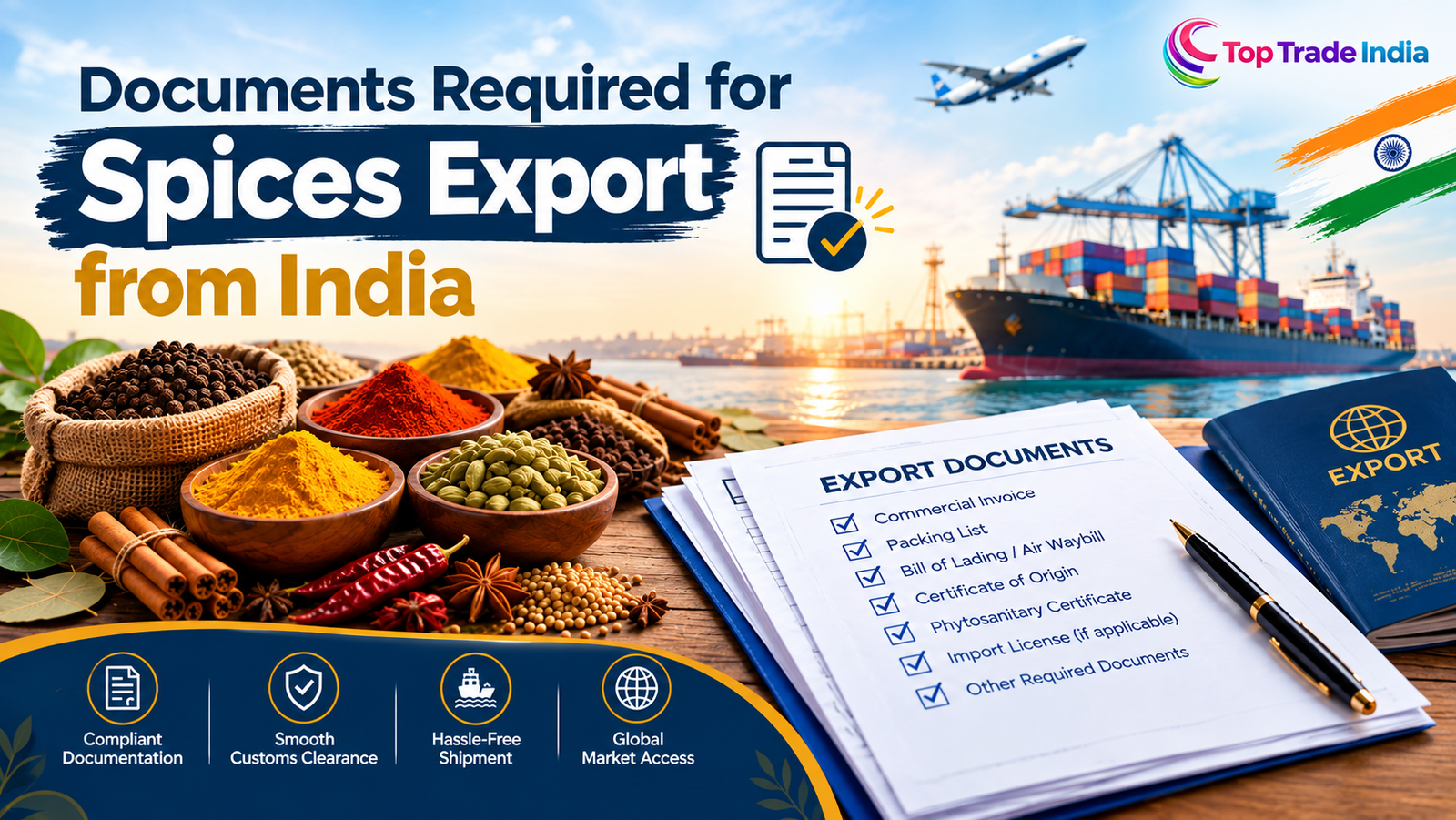
India is one of the world’s leading producers and exporters of spices, including turmeric, chilli, cumin, coriander, cardamom, pepper and many other varieties. With demand increasing across international markets, spice exports can be a profitable opportunity for Indian businesses.
However, before shipping spices to an international buyer, exporters need to complete several registrations and prepare the right documents. Understanding the documents required for spices export from India can help avoid customs delays, shipment problems and unnecessary costs.
1. Import Export Code (IEC)
The Import Export Code (IEC) is one of the most important requirements for businesses involved in exports from India. It is issued by the Directorate General of Foreign Trade (DGFT).
An exporter generally needs a valid IEC to carry out commercial export transactions. The details mentioned in the IEC should match the business and shipping documents.
2. GST Registration and Related Documents
GST registration is important for businesses involved in the supply and export of goods. Exporters may also need relevant GST documentation and invoices for their transactions.
Depending on the export arrangement, businesses can follow applicable procedures such as exporting under a Letter of Undertaking (LUT) or paying IGST and claiming a refund, subject to current regulations.
3. CRES Certificate for Spice Export
For businesses dealing in spices, the Certificate of Registration as an Exporter of Spices (CRES) is an important requirement. The registration is associated with the Spices Board of India.
Exporters should check the latest requirements, product categories and registration conditions applicable to their business before starting shipments.
4. Commercial Invoice
A commercial invoice provides important information about the export transaction. It normally includes details such as:
- Exporter and buyer information
- Product description
- Quantity and unit price
- Total invoice value
- Currency
- Payment terms
- Country of origin
- Applicable trade terms
Accurate invoice information helps customs authorities and buyers process the shipment correctly.
5. Packing List
A packing list gives detailed information about how the spices have been packed for transportation. It may include the number of packages, package type, net weight, gross weight, dimensions and product details.
A clear packing list can make cargo handling and customs verification easier.
6. Shipping Bill
The Shipping Bill is a key customs document required for exporting goods from India. It contains information about the exporter, shipment, goods and declared value.
The exporter or customs agent generally files the shipping bill through the applicable customs system before the goods are exported.
7. Certificate of Origin
Some international buyers or importing countries may require a Certificate of Origin to confirm where the exported spices were produced or manufactured.
It can also be relevant when buyers want to claim benefits available under specific trade agreements, depending on the destination country and applicable rules.
8. Phytosanitary and Other Product Documents
Depending on the type of spice and destination country, additional certificates or inspection documents may be required. A Phytosanitary Certificate may be requested for certain plant-based products to confirm that they meet applicable plant-health requirements.
Importing countries can also have their own requirements related to food safety, residue limits, lab testing, packaging and labeling. Therefore, exporters should always verify the destination country's regulations before shipment.
Final Checklist for Spice Exporters
Before exporting spices from India, businesses should carefully verify their IEC, GST-related documents, CRES registration, commercial invoice, packing list, shipping bill, certificate of origin and any required product-specific certificates.
The exact documentation can vary according to the spice, destination country, buyer requirements and current regulations. Preparing everything correctly in advance can reduce delays and make international trade smoother.
For new exporters, understanding the documents required for spices export from India is an essential first step toward building a reliable and compliant export business.
suggestion link
Call: +91 88264 00869
Website: Top Trade India
Email: info@toptradeindia.com
Follow us on: Instagram , Facebook , YouTube



Comments (0)
No comments yet. Be the first to comment!
Leave a Comment